RX Pad Blog

Clinical Decision Support System Alerts

A blue and green circle with a knot in the middle

HD. After week (W) 96, participants transitioned to daily B/F/TAF to assess whether efficacy and safety would be maintained on this STR that is guidelines-recommended for PLWH with eGFR > 30 mL/min.


Methods. Virologically suppressed adult PLWH with ESRD on chronic HD who completed W96 on E/C/F/TAF enrolled in the B/F/TAF extension for 48 weeks. Efficacy was assessed as the proportion of participants with virologic suppression (HIV RNA < 50 copies/mL). Safety was assessed throughout the study, PK was assessed using sparse sampling at W4, 24 and 48.


Results. 55 enrolled, 36 completed E/C/F/TAF, 10 entered the B/F/TAF extension. The median age was 55 yrs (range 34-63); median time on HD was 4 yrs (range 2-16). All ten participants on B/F/TAF had HIV-1 RNA < 50 c/mL (95% CI 69%, 100%) at W48. All participants had at least 1 adverse event (AE); most were grade 1 or 2 in severity. One participant had a grade 3 AE and 3 had serious AEs; none were considered related to study drug by the investigator. One participant had AEs attributed to study drug (malaise grade 1 and nausea grade 2), which resolved and did not lead to discontinuation of study drug. There were no clinically relevant changes in fasting lipids. In participants with evaluable data (n=2-5 per timepoint), mean bictegravir trough concentrations were lower compared to PLWH not on HD but remained 4- to 7-fold higher than the established protein-adjusted 95% effective concentration (paEC95) of 162 ng/mL against wild-type virus.


Conclusion. A once daily regimen of B/F/TAF maintained virologic suppression in PLWH on chronic HD. B/F/TAF was well-tolerated with no discontinuations. B/F/ TAF may be an effective, safe and convenient once daily STR and ameliorate the need for dose adjustment in appropriate PLWH who require chronic HD.


Disclosures. Joseph J. Eron, MD, Gilead Sciences (Consultant, Research Grant or Support)Janssen (Consultant, Research Grant or Support)Merck (Consultant)ViiV Healthcare (Consultant, Research Grant or Support) Aimee Wilkin, MD, MPH, Gilead Sciences Inc. (Grant/Research Support, Scientific Research Study Investigator, Advisor or Review Panel member)GlaxoSmithKline (Grant/Research Support)Janssen (Grant/Research Support, Scientific Research Study Investigator, Advisor or Review Panel member)Pfizer (Grant/Research Support) Moti Ramgopal, MD FACP FIDSA, AbbVie (Speaker’s Bureau)Allergan (Speaker’s Bureau)Gilead Sciences Inc. (Consultant, Scientific Research Study Investigator, Speaker’s Bureau)Janssen (Speaker’s Bureau)Merck (Consultant)Viiv Healthcare (Consultant) Olayemi Osiyemi, M.D, GlaxoSmithKline (Advisor or Review Panel member, Speaker’s Bureau)ViiV Healthcare (Advisor or Review Panel member, Speaker’s Bureau) Jihad Slim, MD, Abbvie (Speaker’s Bureau)Gilead (Speaker’s Bureau)Jansen (Speaker’s Bureau)Merck (Speaker’s Bureau)ViiV (Speaker’s Bureau) David Asmuth, MD, Gilead Sciences Inc. (Scientific Research Study Investigator) Edwin DeJesus, MD, Gilead Sciences (Advisor or Review Panel member) Polina German, PharmD, Gilead Sciences (Employee) Christiana Blair, MS, Gilead Sciences (Employee, Shareholder) Christoph C. Carter, MD, Gilead Sciences Inc. (Employee, Shareholder) Diana M. Brainard, MD, Gilead Sciences (Employee) Sean E. Collins, MD, MS, Gilead Sciences (Employee) Hal Martin, MD, MPH, Gilead Sciences Inc. (Employee, Shareholder) 1003.


BIC/FTC/TAF Maintains Viral Suppression in Patients with Documented M184V/I Mutations: A Real World Experience Nicholas Chamberlain, MD1 ; James B. Brock, MD, MSCI, FACP1 ; Leandro A. Mena, MD, MPH1 ; 1 University of Mississippi Medical Center, Jackson, Mississippi


Session: P-47. HIV:

Treatment Background. The M184V/I mutation is a common mutation in treatment-experienced patients with HIV and confers high-level resistance to lamivudine and emtricitabine. Our objective is to assess the effectiveness of bictegravir (BIC)/emtricitabine (FTC)/tenofovir alafenamide (TAF) in a real-world setting in achieving and maintaining viral suppression in patients with documented M184V/I mutations.


Methods. This case series is comprised of treatment-experienced HIV-positive patients with documented historical or newly-identified M184V/I mutations who were placed on BIC/FTC/TAF as a switch strategy or as therapy for patients who had failed a prior regimen. Patients with any resistance to tenofovir or bictegravir were excluded. Our primary outcome was sustained viral suppression at 12 months after initiation of BIC/FTC/TAF.


Results. We included 33 patients (94% black, 52% male, median age 49, range 36-63) with an M184V/I mutation. The majority (91%) showed sustained viral suppression at 12 months of treatment. Non-adherence to medication was the common factor in all three cases of treatment failure. One patient developed an R263K mutation while on therapy, which conferred low-level resistance to bictegravir. There were no other instances of newly-acquired resistance to any of the components of BIC/FTC/TAF.


Conclusion. Our results demonstrate high success rates of BIC/FTC/ATF in achieving and maintaining viral suppression in patients with documented M184V/I mutations who adhere to medications in a real-world setting with a single instance of new treatment-emergent resistance to bictegravir. These findings are congruent with reported sub-group analysis in clinical trial data and support the use of BIC/FTC/TAF in patients with M184V/I mutations.


Disclosures. Leandro A. Mena, MD, MPH, Binx Health (Grant/Research Support)Evofem (Grant/Research Support)Gilead Science (Consultant, Grant/ Research Support, Speaker’s Bureau)GSK (Grant/Research Support)Janssen (Grant/ Research Support)Merck (Consultant, Grant/Research Support)Roche Molecular (Consultant, Grant/Research Support)SpeedDx (Grant/Research Support)ViiV Healthcare (Consultant, Grant/Research Support, Speaker’s Bureau)


1004. Clinical Decision Support System Alerts for HIV Retention in Care – A Pilot Implementation Research Study Michael Leonard, MD1 ; Rachel P. Weber, PhD2 ; Laurence Brunet, PhD2 ; Bernard Davis, PhDc, MBA3 ; Christopher Polk, MD1 ; Joel Wesley Thompson, MHS, PA-C, AAHIVS, DFAAPA, MHS, PA-C, AAHIVS, DFAAPA4 ; Jennifer S. Fusco, BS2 ; Tammeka Evans, MoP5 ; Pedro Eitz Ferrer, PhD, Master of Health Communication6 ; Rodney Mood, BS, MBA2 ; Gregory Fusco, MD, MPH2 ; 1 Atrium Health, Charlotte, North Carolina; 2 Epividian, Inc., Durham, North Carolina; 3 RAO Community Health, Charlotte, North Carolina; 4 Amity Medical Group, Charlotte, North Carolina; 5 ViiV Healthcare, Research Triangle Park, NC; 6 TBWA/WORLDHEALTH, New York, New York


Session: P-47.

HIV: Treatment Background. Clinical decision support system (CDSS) alerts may help retain people living with HIV (PLWH) in care. A system of CDSS alerts utilizing the CHORUS™ portal was developed to identify PLWH at risk of being lost to care. To evaluate feasibility for a larger scale study, a before and after implementation research pilot study was implemented in the OPERA Cohort at three clinic sites in a southeastern US city.


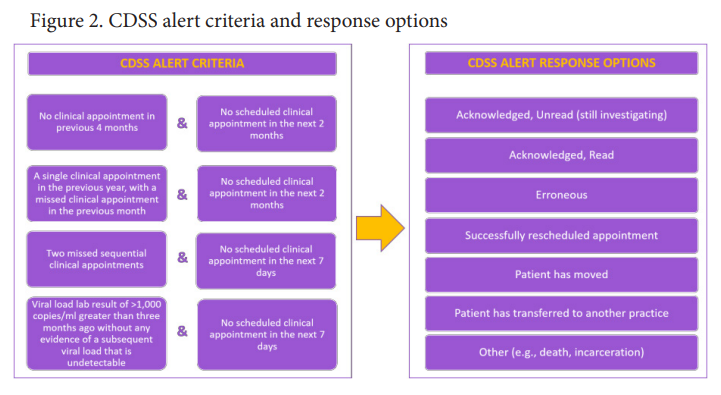
Methods. Periods without intervention (before) or with CDSS alerts (after) were followed by 3 months of follow up. The study population consisted of PLWH with ≥ 1 electronic health record entry in the 2 years prior to, or during, the before or after period (Fig 1). To support clinicians through a discrete implementation strategy, alerts warning of suboptimal patient attendance were generated daily for the eligible PLWH at each site; providers or other clinic staff could respond to the alerts (Fig 2). Alerts, responses, and visits (i.e., meeting with provider or HIV lab measurement) were characterized. The proportion of PLWH with ≥ 1 visit in the before and after periods were compared at each site by Pearson’s Chi-square.


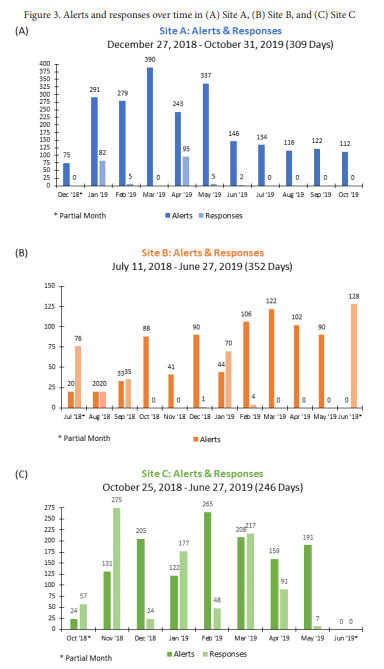
Results. A total of 12,230 PLWH were eligible (sites A: 11,271; B: 733; C: 1,344 PLWH), with > 75% in both the before and after periods. The ratio of alerts to responses was 11.9 at site A (2,245 alerts to 189 responses in 309 days; Fig 3A), and comparatively lower at sites B (756 alerts to 334 responses in 352 days, ratio=2.2; Fig 3B) and C (1,305 alerts to 896 responses in 246 days, ratio=1.5; Fig 3C). Responses to alerts were sporadic at sites A and B and consistent at site C. After the intervention, the proportion of PLWH with ≥ 1 visit stayed the same at site A (46% in both periods; p=0.47), decreased at site B (91% to 80%; p< 0.01), and increased at site C (72% to 81%; p< 0.01).


Conclusion. This pilot study was ecological by design: measures of retention in care were compared over two calendar periods, without accounting for changes in study populations, clinic characteristics, and policies in place over time (which could have impacted clinic attendance). Though engagement with the CDSS was suboptimal at some sites, this implementation pilot study has demonstrated the ability to implement a CDSS aimed at identifying at-risk PLWH, while highlighting areas for improvement in future larger scale studies.


Disclosures. Joel Wesley Thompson, MHS, PA-C, AAHIVS, DFAAPA, MHS, PA-C, AAHIVS, DFAAPA, Gilead (Shareholder, Speaker’s Bureau)Janssen (Speaker’s Bureau)Theratechnologies (Speaker’s Bureau)ViiV (Speaker’s Bureau) Tammeka Evans, MoP, ViiV Healthcare (Employee)


1005. Comparison of Weight Changes in Treatment-Naïve, HIV-Infected Patients Receiving Integrase Inhibitor-Based Therapy Versus Protease Inhibitor-Based Therapy Zachary Howe, PharmD1 ; Eric Farmer, PharmD, BCPS, AAHIVP2 ; Brooke Stevens, PharmD, BCPS, AAHIVP2 ; Emily Huesgen, PharmD, BCACP, AAHIVP3 ; 1 Indiana University Health AHC, Indianapolis, Indiana; 2 Indiana University Health LifeCare Clinic, Indianapolis, Indiana; 3 Indiana University Health, Ellettsville, Indiana


Session: P-47. HIV:

Treatment Background. Recent data regarding integrase inhibitor (INSTI) therapy indicate possible association with weight gain. The incidence and degree of weight gain seems to vary by both patient-specific and regimen-related factors, such as nucleoside reverse transcriptase (NRTI) backbone.


Methods. This was a retrospective chart review of previously ART-naïve Indiana University Health LifeCare Clinic patients who started an INSTI- or PI-based regimens from 1/1/13 to 7/31/19. Adult patients without prior ART exposure receiving an INSTI- or PI-based regimen for at least 10 months were included. The primary objective was weight gain at 12 months after starting ART. Subgroup analyses were conducted by INSTI, PI, or NRTI backbone utilized. Statistical testing included Wilcoxon Rank-Sum Test and Chi Square analyses.


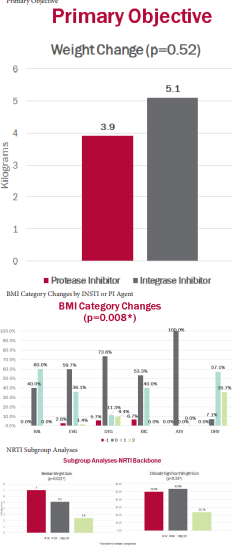
Results. The patient population (N=162) was predominately male and African American with relative immunocompetence, generally achieving viral suppression after 12 months of ART. Patients receiving PI-based therapy were more likely to be Asian American or Hispanic (p=0.04), and to receive a tenofovir disoproxil fumarate (TDF)-based regimen (p=0.0034). No statistically significant difference in weight change was observed between INSTI- and PI-based regimens (median weight gain 5.1 kg vs 3.9 kg, p=0.52). The proportion of obese or overweight patients in the INSTI arm increased significantly as compared to baseline (p=0.00001). Subgroup analyses demonstrated significant increases in weight gain and clinically significant weight gain with tenofovir-based (tenofovir alafenamide and TDF) regimens compared to those with abacavir/lamivudine (p< 0.05).

A blurred image of a pilot study timeline
A diagram of cdss alert criteria and response options
A few graphs on a white background with numbers on them
A graph showing a primary objective weight change

Authors: Michael Leonard, Rachel P Weber, Laurence Brunet, Bernard Davis, Christopher Polk, Joel Wesley Thompson, Jennifer S Fusco, Tammeka Evans, Pedro Eitz Ferrer, Rodney Mood, Gregory Fusco.

Read More From Amity Medical Group

August 28, 2026
Dehydration happens when your body loses more fluids than it gets. Even if mild dehydration seems like a minor issue, not drinking enough can impact many parts of your body. Water helps control your temperature, keeps your blood moving, helps your kidneys remove waste, and supports normal body functions. Knowing the signs, causes, and effects of dehydration can help you stay hydrated and support your health. What Is Dehydration? Dehydration means your body doesn't have enough fluid to work properly. You lose water all the time through urination, sweating, breathing, and other daily activities. You may need more fluids if you exercise, are sick, are in hot weather, or take certain medicines. Increased thirst Dry mouth or lips Dark-colored urine Urinating less frequently Fatigue or weakness Headache Dizziness or lightheadedness Difficulty concentrating Severe dehydration could disrupt normal body functions and may require prompt medical care. How Dehydration Affects Your Body Water is important for almost every part of your body, so dehydration affects much more than just making you feel thirsty. Brain and mental function: Even mild dehydration may contribute to headaches, tiredness, difficulty concentrating, and changes regarding alertness. Heart and circulation: Having enough fluids helps keep your blood volume normal. If you get dehydrated, your blood pressure and heart rate can change, especially if you are older or have certain health problems. Kidneys and urinary system: Your kidneys need enough fluids to remove waste from your blood. Dehydration can make your urine darker and may raise the risk of kidney stones and other urinary problems. Muscles and joints: Fluids help your muscles work well. If you are dehydrated, you might get muscle cramps, feel weak, or not perform as well physically. Digestive health: Drinking enough water helps your digestion and can prevent constipation. Common Causes and Risk Factors Dehydration can happen for many reasons, including: Not drinking enough water throughout the day. Heavy sweating while engaging in physical activity Fever Vomiting or diarrhea Certain medications Spending extended periods in hot conditions Increased fluid needs during illness Older adults are at higher risk because they may not feel as thirsty as they age. People with some health conditions should also watch their fluid intake closely. Tips for Being Hydrated Maintaining hydration is simple if you build a few good habits, such as: Intaking fluids regularly throughout the day Keeping water nearby at home, work, or while traveling Drinking additional fluids while exercising Eating foods containing a lot of water, such as fruits and vegetables Paying attention to urine color as one general indicator of hydration Following a healthcare provider’s recommendations if you have fluid restrictions Water is a great choice for daily hydration, but how much you need depends on your age, activity, medicines, and health. When to Speak with a Medical Provider Talk to a medical provider if dehydration symptoms do not go away, get worse, or are hard to manage. Severe dehydration can cause confusion, fainting, very little urination, extreme weakness, or a fast heartbeat and may need urgent medical care. Protecting Your Health Through Proper Hydration It is easy to forget about dehydration, but drinking enough fluids is important for your health. Remaining hydrated helps your brain, heart, kidneys, muscles, digestion, and many other body functions.  If you drink fluids regularly, watch for early signs of dehydration, and talk to your medical professional about any concerns, you can make hydration part of your daily routine. Amity Medical Group encourages you to take charge of your health and discuss your hydration needs during regular checkups.
July 31, 2026
Metabolic syndrome is a plethora of health conditions that happen together, increasing the chances of heart disease, stroke, type 2 diabetes, and chronic conditions. Because it often develops gradually without symptoms, many people may be unaware they are at risk. Early recognition and healthy lifestyle changes can prevent serious complications and support sustained health. Understanding metabolic syndrome and its associated risk factors helps individuals to take informed decisions that protect their overall health. What Is Metabolic Syndrome? Metabolic syndrome is not one disease but a combination of several that occur simultaneously. A healthcare provider may diagnose metabolic syndrome when a person has three or more of the following: Elevated blood pressure High blood sugar levels Excess body fat around the waist High triglyceride levels Low levels of HDL (“good”) cholesterol Each of these conditions places additional strain on the body’s cardiovascular and metabolic systems. Together, they greatly increase the risk of serious health complications. Higher blood sugar can damage blood vessels over time, while high blood pressure places extra stress on the heart and arteries. Abnormal cholesterol and triglyceride levels may contribute to plaque buildup in the blood vessels, reducing healthy circulation. Without proper management, metabolic syndrome may increase the risk of: Heart disease Stroke Type 2 diabetes Kidney disease Fatty liver disease Many of these risks can be reduced through early detection and consistent lifestyle changes. Common Risk Factors Certain variables may increase the likelihood of developing metabolic syndrome, including: Excess body weight, especially around the abdomen Physical inactivity Diets high in processed foods, added sugars, and rich in saturated fats Increasing age Family history of diabetes or heart disease Smoking or tobacco use Poor sleep habits Ongoing stress Some risk factors cannot be changed, but many can be adjusted through healthy habits and regular medical care. Supporting Metabolic Health Every Day Healthy lifestyle actions play a key role in preventing and managing metabolic syndrome. Small, consistent changes can improve health and reduce future risk. Helpful habits include: Eating a well-rounded diet with food groups like vegetables, fruits, whole grains, low-fat proteins, and healthy fats Limiting sugary beverages, processed foods, and excess sodium Participating in rregularly scheduled physical activity, such as walking, cycling, or strength training Maintaining a healthy weight Getting consistent, sound rest each night Avoiding tobacco products Scheduling routine wellness visits and recommended health screenings Healthcare providers may recommend medications to manage blood pressure, cholesterol, or blood sugar when lifestyle changes are insufficient. When to Speak with a Medical Provider Metabolic syndrome often develops without symptoms, so routine health screenings are essential. Speak with a medical provider if you experience or have concerns about: Elevated blood pressure readings High blood sugar or prediabetes Increasing waist circumference Abnormal cholesterol or triglyceride levels Unexplained fatigue A family history of heart disease or diabetes Regular checkups let healthcare providers monitor health indicators and recommend preventive care before complications arise. Protecting Your Long-Term Health Metabolic syndrome is called a “silent” health risk because it can progress unnoticed for years. It is also one of the most controllable chronic concerns when identified early. Healthy nutrition, regular physical exercise, routine medical care, and attention to key health measurements can greatly lower the risk of serious complications. Taking a proactive approach to metabolic health today can support healthier aging, enhance overall well-being, and minimize the chances of chronic disease in the years ahead. 
June 22, 2026
Cardiovascular-kidney-metabolic (CKM) health describes the complex, interconnected relationship among the heart, kidneys, and metabolic system. These systems collectively regulate blood flow, filter waste, and manage energy utilization. Dysfunction in one system can increase strain on the others, therefore increasing the probability of chronic conditions over time. An extensive understanding of CKM health is key to effective prevention, early intervention, and sustained wellness. Contemporary healthcare increasingly recognizes the interdependence among heart, kidney, and metabolic conditions, underscoring the need for coordinated management strategies. Understanding the CKM System The cardiovascular system circulates blood and delivers oxygen and nutrients throughout the body. The kidneys sift through waste from the blood, regulate fluid balance, and maintain blood pressure. The metabolic system manages how the body processes sugar and fats, using them for energy or storing them for later use. Optimal function of these systems ensures overall physiological efficiency. Impairment in one system can initiate a cascade of adverse effects. For instance, elevated blood pressure may damage blood vessels in both the heart and kidneys. Likewise, impaired blood sugar regulation can increase vascular strain and diminish renal efficiency over time. How CKM Conditions Are Connected Due to the close interrelationship among these systems, health concerns frequently overlap. Common associations include: • Elevated blood pressure resulting in both heart strain and reduced kidney function • Blood sugar imbalance impacting blood vessels and organ performance • Reduced kidney function impacting fluid balance and cardiovascular workload • Excess body weight increases the strain on metabolic and cardiovascular processes • High cholesterol affects blood vessel health and circulation These conditions typically develop gradually, stressing the importance of routine monitoring and early intervention. Risk Factors for CKM Health Concerns Multiple factors add to the chances of developing cardiovascular-kidney-metabolic conditions, including: • Diets high in sodium, added sugars, and processed foods • Limited physical activity or prolonged inactivity • Tobacco use • Ongoing stress and poor sleep habits • Family history of heart, kidney, or metabolic conditions • Excess body weight • Uncontrolled blood pressure, cholesterol, or blood sugar levels Given the interconnection of these risk factors, addressing one area frequently yields benefits across all three systems. Supporting CKM Wellness Through Daily Habits Maintaining cardiovascular-kidney-metabolic health requires consistent, evidence-based habits that promote general physiological well-being: • Eating a balanced diet with fruits, vegetables, low-fat proteins, and whole grains • Staying physically active through walking, stretching, or other regular movement • Drinking enough water to support kidney function • Keeping an eye on blood pressure, blood sugar, and cholesterol levels • Prioritizing steady sleep routines • Reducing tobacco use and limiting unhealthy lifestyle habits • Attending regular medical checkups for prompt detection and prevention Incremental and sustained habit changes can substantially lower the risk of long-term complications. When to Seek Medical Guidance Consultation with a medical provider is recommended if any of the following symptoms are observed: • Ongoing fatigue or low energy levels • Swelling in the legs, ankles, or feet • Difficulty managing blood pressure or blood sugar • Changes in urination patterns • Shortness of breath or chest discomfort • Unexplained changes in weight or appetite Early evaluation helps identify fundamental health concerns and enables early intervention. A Whole-System Approach to Health Cardiovascular-kidney-metabolic health underscores the need to consider the body as an integrated system. Identifying the interactions among the heart, kidneys, and metabolic functions enables a more all-encompassing approach to prevention and treatment for both individuals and medical providers. Prioritizing CKM health increases energy levels, optimizes organ function, and reduces the chance of chronic disease. Consistent habits, adjustments, and active medical management help to improve overall wellness and favorable long-term health outcomes.
Show More